
Eligibility Transactions: Real-Time Verification That Protects Every Claim
Most claims problems don’t start at the billing stage. They start earlier, at the moment someone assumes a member is covered without actually confirming it. By the time the error surfaces, the claim has already moved through repricing, adjudication, and payment. Unwinding it costs time, money, and provider goodwill that’s hard to get back.
ClaimsBridge handles eligibility and benefits verification transactions — the 270/271 transaction set — as a core part of claims intake. We connect eligibility confirmation to the claims workflow so your team is working with accurate, real-time data before a claim ever enters adjudication.
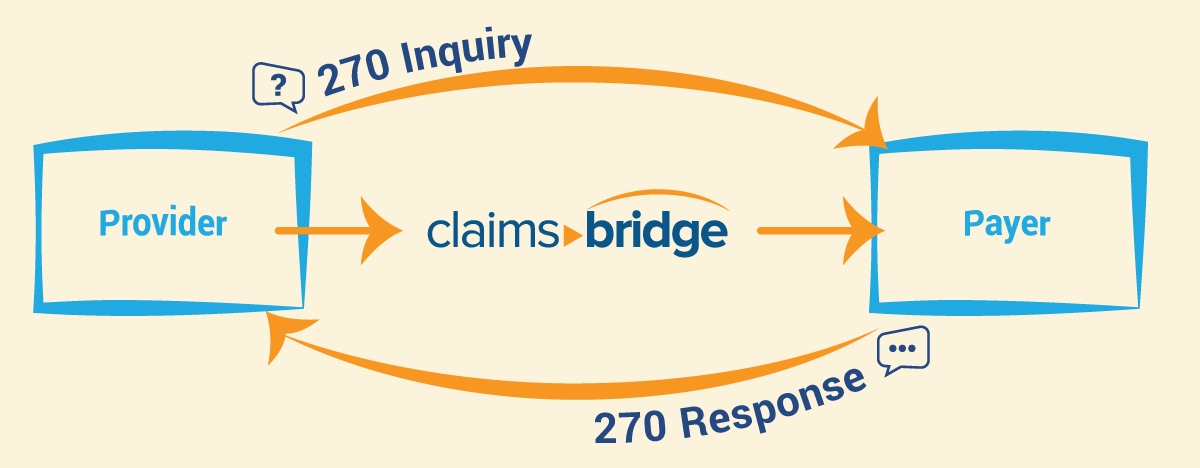
The 270 is an eligibility inquiry. When a provider, TPA, or clearinghouse needs to confirm that a member is covered and what their benefits look like, they send a 270 transaction to the payer’s system. The payer responds with a 271: a detailed eligibility and benefits response that answers specific, real-time questions about that member’s coverage.
This is not the same as checking a static enrollment roster. The 270/271 transaction set answers precise, context-dependent questions:
A weekly enrollment file can’t answer those questions accurately. An eligibility transaction can.
ELIGIBILITY AND BENEFITS VERIFICATION ACCOUNTS FOR 54% OF ALL MEDICAL ADMINISTRATIVE TRANSACTIONS
(according to the 2023 CAQH Index). It is the highest-volume transaction in the industry, and still one of the leading causes of preventable claim denials.
Eligibility errors compound. One inaccurate data point at intake doesn’t stay contained — it moves through the entire claims workflow, triggering incorrect pricing, wrong copay application, or a denial of a service that was actually covered. Fixing it post-adjudication requires manual intervention, claim reprocessing, and in some cases, chasing providers for refunds. That recovery process is one of the most inefficient and abrasive activities in healthcare administration.
Most failures aren’t the result of bad systems or bad people. They’re the result of data latency: the gap between when a change happens — a termination, a plan change, a new enrollment — and when the claims system actually reflects it. That gap is where errors live.
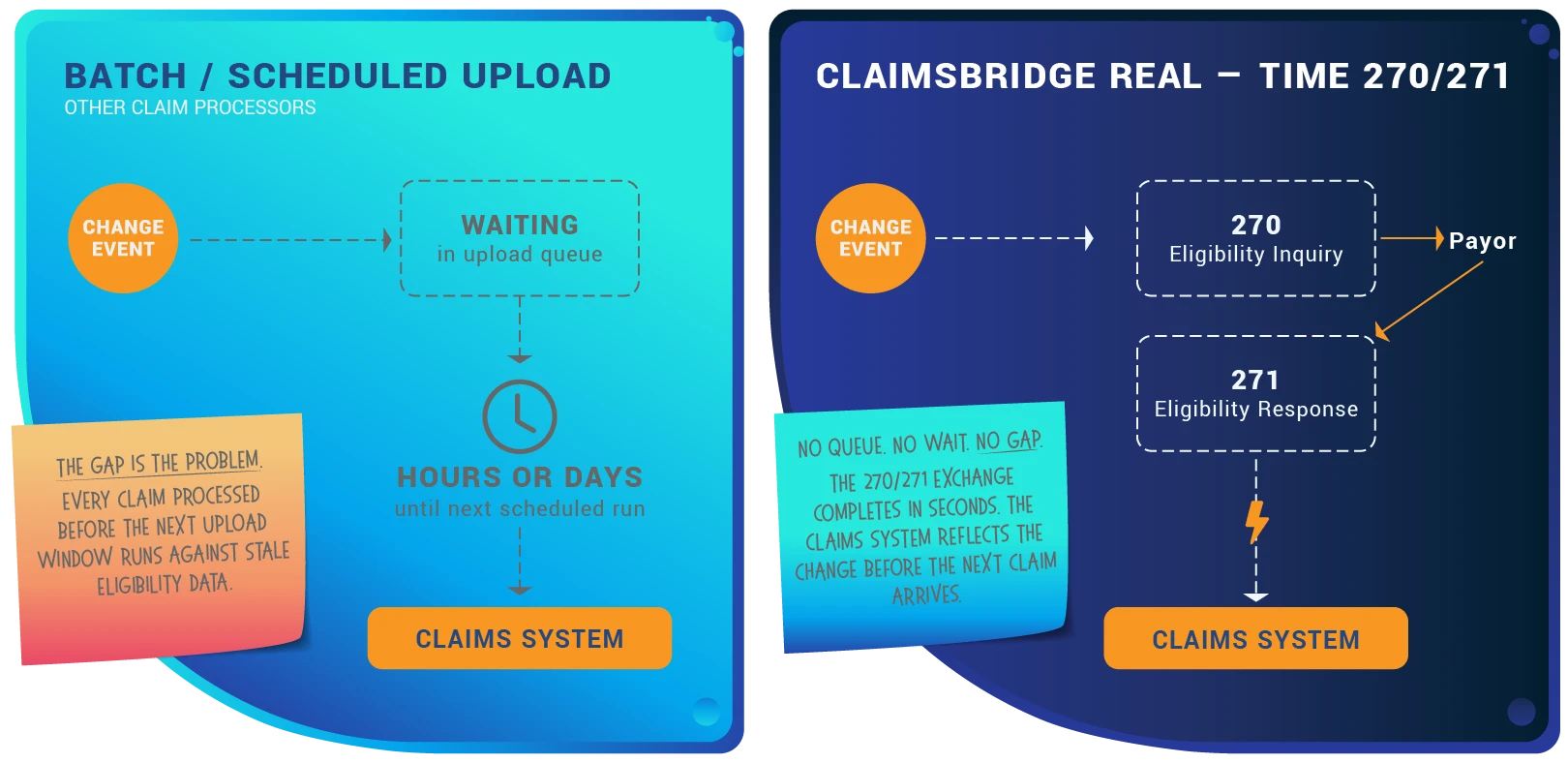
Real-Time Operations
ClaimsBridge operates the 270/271 process in real time, working with a specialized vendor partner to deliver it. We supply the vendor with the data they need: eligibility files, accrual files, and benefit files. When a provider submits a 270 inquiry, the vendor responds with a 271. The process runs as a separate flow from TPA adjudication, purpose-built for the speed and precision that real-time verification requires.
Validation & Coordination
Our role does not stop at data delivery. Before files reach the vendor, ClaimsBridge runs a validation step that catches issues likely to create rejections downstream. If a problem surfaces in the 270/271 process itself, we coordinate directly with both the vendor and the TPA or client to resolve it. You are not left managing two separate relationships or translating between them. We handle that.
Transparency
Transparency is a deliberate priority. TPAs working with ClaimsBridge on eligibility transactions get clear visibility into the process and as much hands-on support as they need to meet the standards required. The goal is to make this as straightforward as possible for your team — not to add another technical relationship you have to manage on your own.
Adjudication Accuracy
When eligibility data is accurate at intake, every downstream function works better. Adjudication logic fires correctly. Deductibles accumulate accurately. Copays apply as intended. Auto-adjudication rates improve because the variable most likely to trigger manual review has been eliminated.
Provider Relationships
Provider relationships benefit too. Nothing damages a provider’s trust faster than a payment that gets recouped months later over an eligibility issue that should have been caught upfront. Accurate verification reduces provider abrasion and the volume of calls to your contact center.
Stop-Loss & IBNR
For self-funded plans and stop-loss carriers, the financial stakes are equally clear. Accurate eligibility data means more reliable IBNR estimates and fewer dollars paid out in error — dollars that are difficult or impossible to recover once they have moved through the system.
If your current workflow is still relying on scheduled file loads to confirm member eligibility, there is a better way. ClaimsBridge brings real-time verification into the claims workflow so your team has accurate information at the moment it matters, not after the fact.
Contact us to learn how ClaimsBridge handles eligibility transactions as part of a fully integrated pre-adjudication workflow.